
The infrared vs traditional sauna debate carries real weight — this isn't marketing noise. These two technologies heat the body through different physical mechanisms, operate at fundamentally different temperatures, and have built separate evidence bases over decades of research. The confusion is understandable: both produce sweating, both raise core temperature, and both are sold with similar wellness claims. But the differences matter, especially if you're making a purchasing decision.
This guide covers the actual science — including where infrared research is solid, where traditional sauna has the edge, and where both camps are overselling their benefits. We'll also give you the practical numbers that matter for home installation and daily use.
How They Work: The Physics
The fundamental difference between infrared and traditional sauna is what gets heated. Traditional sauna heats the air; infrared heats your body directly. This distinction drives every downstream difference in temperature, physiology, and experience.
Traditional Finnish Sauna
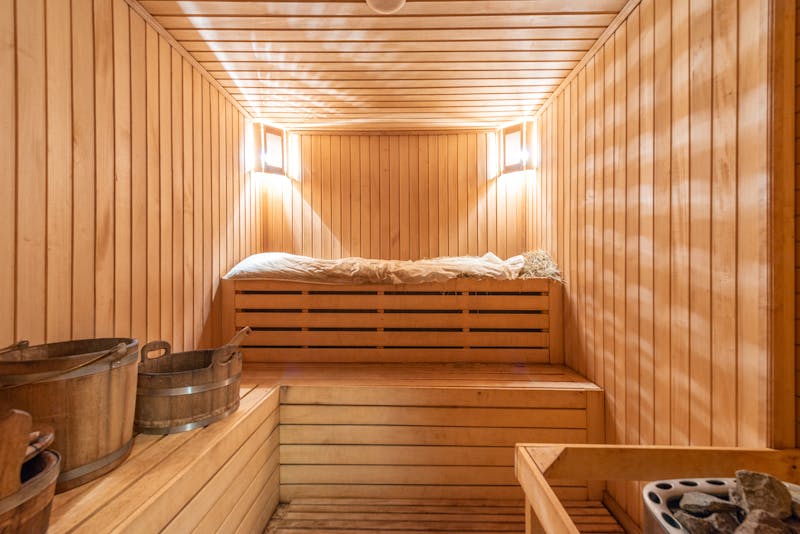
A traditional sauna uses an electric or wood-burning heater loaded with rocks (called a kiuas) to heat the air in the room to 80–100°C (176–212°F). You then ladle water onto the rocks to create steam (löyly), which raises humidity and intensifies the heat sensation on your skin. Your body absorbs heat primarily through two mechanisms:
- Convection: hot air surrounds your skin and transfers heat at its surface
- Conduction: contact with hot wooden benches transfers heat directly
The result is a rapid and intense thermal stress. Core body temperature can rise 2–3°C within 15–20 minutes. Heart rate increases to 100–150 bpm — comparable to moderate aerobic exercise. Sweat volume is high: studies report 0.5–1 liter of sweat per session in traditional Finnish sauna. The experience is physically demanding, which is part of why it produces such measurable physiological responses.
Infrared Sauna
Infrared saunas use ceramic or carbon panel emitters mounted on the walls and floor to emit far-infrared electromagnetic radiation in the 7–14 micrometer wavelength range. This radiation penetrates directly into body tissues — estimated at 1.5–2 inches (approximately 3–5 cm) deep — without significantly heating the air between the emitter and your skin. Ambient air temperature stays at 45–60°C (113–140°F), which feels comparatively mild.
Because the heat source works at the tissue level rather than the air level, you can achieve core temperature rises of 1–3°C and comparable sweating to traditional sauna at ambient temperatures that are 30–40°C cooler. Sessions are typically longer (30–45 minutes vs 15–20 minutes for traditional) and more comfortable for people who find extreme heat intolerable.
Full-Spectrum Infrared: Near, Mid, and Far
Most home infrared saunas use far-infrared (FIR) only. "Full-spectrum" units add near-infrared (NIR, 0.75–1.4 μm) and mid-infrared (MIR, 1.4–3 μm) wavelengths. Here's the claimed difference:
- Near-infrared (NIR): Shortest wavelength, penetrates only the skin surface (a few mm). Associated with cellular repair and red light therapy effects — some overlap with photobiomodulation research. Most commonly used in targeted panel devices, not saunas.
- Mid-infrared (MIR): Penetrates soft tissue, potentially reaching lymph nodes and muscles. Some manufacturers claim superior cardiovascular and detox benefits vs FIR alone.
- Far-infrared (FIR): The longest infrared wavelength; deepest tissue penetration. Best studied in sauna research context. Most home infrared saunas use FIR exclusively.
The honest caveat: most clinical infrared sauna research was conducted on FIR units specifically. Full-spectrum claims often extrapolate from separate NIR photobiomodulation research that was done with targeted panels, not whole-body saunas. The additional benefit of full-spectrum over FIR-only in a sauna context has not been rigorously tested.
The Research Problem: An Unequal Evidence Base
Before diving into specific benefits, you need to understand a structural problem with sauna research: almost all large-scale, long-term health studies were done on traditional Finnish saunas. Extrapolating those results to infrared is reasonable but not proven.
The Finnish Studies
The most influential sauna health research comes from the Kuopio Ischemic Heart Disease (KIHD) study — a prospective cohort study tracking 2,315 Finnish middle-aged men for over 20 years. Lead researcher Jari Laukkanen and colleagues published landmark findings across multiple papers:
- Laukkanen et al. 2015 (JAMA Internal Medicine): Men who used sauna 4–7 times per week had a 66% lower risk of fatal cardiovascular events and 65% lower risk of Alzheimer's disease compared to once-weekly users. A dose-response relationship was clear — more sauna use, greater benefit.
- Laukkanen et al. 2017 (Age and Ageing): Frequent sauna use associated with reduced risk of dementia and Alzheimer's.
- Laukkanen et al. 2018 (Mayo Clinic Proceedings): Sauna bathing associated with reduced risk of sudden cardiac death and all-cause mortality.
Critical caveat: These studies used traditional Finnish saunas at 80–100°C. They are observational (not RCTs), so they show association, not causation. And they cannot be directly applied to infrared sauna, which operates at fundamentally different temperatures and heating mechanisms.
The Infrared Evidence Base
Infrared sauna research is growing but remains smaller in scale. Most infrared studies are short-term RCTs or pilot studies with fewer participants. A 2009 systematic review by Beever in the Canadian Family Physician concluded there was "limited moderate evidence" for far-infrared sauna in normalizing blood pressure and treating congestive heart failure, and "fair evidence from a single study" for chronic pain.
This doesn't mean infrared doesn't work — it means the evidence hasn't accumulated to the same scale as traditional sauna. The mechanisms (core temperature rise, heat shock protein activation, cardiovascular stress) are similar enough that benefit is physiologically plausible. But "plausible" and "proven at population scale" are different things.
Health Benefits by Type: What's Actually Proven
Traditional Sauna: What the Evidence Supports
Cardiovascular health: The Laukkanen KIHD studies provide the strongest evidence for any sauna type on any outcome. Regular traditional sauna use is associated with significant reductions in cardiovascular death, fatal coronary artery disease, sudden cardiac death, and all-cause mortality. The proposed mechanisms include: reduced arterial stiffness, improved endothelial function, decreased resting blood pressure, and cardiovascular conditioning through heat stress.
Blood pressure reduction: Multiple studies show acute blood pressure reduction following traditional sauna. One Finnish study found systolic BP dropped an average of 7 mmHg in the 30 minutes post-sauna.
Cognitive health / dementia risk: The KIHD data found a 66% lower risk of dementia and 65% lower risk of Alzheimer's in men using sauna 4–7x weekly. The proposed mechanism involves heat shock proteins protecting neurons, improved cerebrovascular function, and reduced inflammatory markers.
Growth hormone: Multiple studies confirm that traditional sauna at 80–100°C produces substantial growth hormone release — one study found 5-fold increases after a single session. This likely requires the intense heat stress of traditional temperatures; infrared's milder thermal load may not produce equivalent GH response.
Infrared Sauna: What the Evidence Supports
Chronic pain and joint conditions: This is where infrared sauna has its clearest dedicated evidence. A pilot study published in Clinical Rheumatology (van Middendorp et al., 2009) examined far-infrared sauna in patients with rheumatoid arthritis and ankylosing spondylitis. Results showed statistically significant reductions in pain and stiffness (p < 0.05 for RA, p < 0.001 for AS), with good tolerance and no adverse effects or disease exacerbation. The authors noted a trend toward long-term beneficial effects beyond the treatment period.
Cardiac rehabilitation: Several Japanese studies on "Waon therapy" (a mild far-infrared sauna protocol at 60°C) found benefits for patients with chronic heart failure — improved exercise tolerance, reduced plasma norepinephrine, and improved endothelial function. This is notable because these patients couldn't tolerate traditional sauna temperatures.
Blood pressure: The Beever 2009 review found moderate evidence for far-infrared sauna improving blood pressure. A Finnish trial found 3 weeks of infrared sauna use significantly reduced both systolic and diastolic BP in hypertensive patients.
Fibromyalgia: A 2023 RCT in PMC examining water-filtered infrared-A whole-body hyperthermia found significant pain reduction vs sham treatment in fibromyalgia syndrome patients, with effects lasting beyond the treatment period.
Muscle recovery: A 2015 PubMed clinical study found far-infrared therapy improved muscle recovery after intense training compared to passive recovery methods, likely through increased circulation and reduced inflammation.
The Detox Question: Separating Fact from Marketing
Few sauna claims generate more misinformation than "infrared sauna removes 7x more toxins." Let's address this directly.
The claim typically traces back to a single industry-funded report stating that infrared sweat is 20% toxins vs 3% for traditional sauna. This is not credible research. Sweat is approximately 98–99% water regardless of heat source. The remaining fraction contains electrolytes, trace minerals, and very small amounts of some metabolic waste products — not "toxins" in any clinically meaningful concentration.
What does legitimate research say? A 2022 study published in PMC (pmc.ncbi.nlm.nih.gov/articles/PMC9546416/) analyzed sweat from 22 participants using water-filtered infrared-A (wIRA) sauna and found higher concentrations of certain inorganic ions (including some heavy metals) compared to sweat from conventional exercise or wet sauna. This is a real finding, but it's preliminary, from a small sample, and doesn't support claims about "20% toxin" content.
A more honest framing: sauna may support the body's natural elimination pathways by increasing sweating, which can excrete small amounts of heavy metals (lead, mercury, cadmium) and some fat-soluble compounds. Whether infrared achieves this more effectively than traditional sauna is unresolved. What's clear is that your liver and kidneys handle the vast majority of detoxification regardless of sauna type — sweat is a minor pathway. Neither sauna type is a substitute for healthy organ function or a practical treatment for toxic exposures.
Dr. Walter Crinnion's 2011 review in Alternative Medicine Review examined sauna as a clinical tool for detoxification and found evidence that heat therapy can support elimination of fat-soluble toxicants — but noted that protocols varied widely and most evidence came from traditional sauna or heat therapy generally, not infrared specifically.
Practical Comparison: Home Installation & Operating Costs
For most buyers, the practical differences outweigh the research nuances. Here's what actually matters for a home sauna decision:
| Factor | Traditional Finnish | Infrared (1–2 person) |
|---|---|---|
| Operating temperature | 80–100°C (176–212°F) | 45–60°C (113–140°F) |
| Core temp rise per session | 2–3°C | 1–3°C |
| Sweat volume | High (0.5–1L/session) | Moderate–high (0.3–0.7L) |
| Heat-up time | 30–45 minutes | 10–15 minutes |
| Typical session length | 15–20 minutes | 30–45 minutes |
| Electricity cost per session | $0.50–$1.50/hr | $0.25–$0.75/hr |
| Power requirement | 240V dedicated circuit (6–12kW heater) | 120V (most 1–2 person); 240V for 3+ person |
| Installation complexity | High — requires ventilation, waterproofing, 240V | Low–moderate — most plug into standard outlets |
| Starting price (home unit) | $2,000–$5,000 (heater + prefab kit) | $700–$3,000 |
| Maintenance | Replace heater rocks periodically; wood sealing | Minimal — panels have no moving parts |
| Comfort for beginners | Challenging — intense heat and steam | Accessible — lower temp, dry environment |
| Social use | Excellent — communal tradition, scalable space | Limited — most home units are 1–2 person |
| Outdoor installation | Excellent — standard outdoor design | Generally indoor; some weatherproof outdoor models |
The operating cost difference adds up over time. A traditional sauna used 4x per week costs roughly $200–$400 more per year to run than an equivalent infrared unit. Over a 5-year ownership period, that's $1,000–$2,000 in extra electricity — often more than the initial price difference between units.
The heat-up time difference is underrated. A 30–45 minute preheat for traditional sauna means significant planning overhead — you won't spontaneously add a sauna session before work. Infrared's 10–15 minute preheat removes that friction, which matters enormously for consistency. And consistency is the variable that most determines long-term health outcomes, not which type you use.

Who Should Choose Which
Choose Traditional Finnish Sauna If:
- Research fidelity matters to you. The strongest long-term cardiovascular and longevity research was done specifically on traditional Finnish sauna. If you want the sauna experience closest to what's proven in population studies, this is it.
- You want the intense heat experience. The löyly ritual — steam from water on rocks, intense heat waves, the sharp contrast of cold plunge afterward — is a cultural and sensory experience that infrared simply doesn't replicate.
- You're installing outdoors. Traditional barrel saunas and custom-built outdoor sauna sheds are purpose-designed for outdoor environments and are far more established than infrared outdoor models.
- You want social use. Traditional saunas scale naturally — 6-person barrel saunas are common. Most infrared units max out at 2–3 people uncomfortably.
- Contrast therapy is your goal. Cold plunge + traditional sauna is the protocol used in virtually all contrast therapy research. The temperature differential from traditional sauna to cold water is greater, producing stronger hormetic stress.
- You can handle the installation requirements. Dedicated 240V circuit, proper ventilation, and ideally an outdoor or basement installation are needed. If your space supports it, the traditional sauna experience is worth it.
Choose Infrared Sauna If:
- Daily use and consistency are the goal. The 10–15 minute heat-up, lower operating cost, and more comfortable temperatures make daily infrared sessions realistic in a way that traditional sauna often isn't.
- You're managing chronic pain or joint conditions. The clinical rheumatology research on infrared sauna for RA and AS is specific to infrared. The penetrating far-infrared heat may provide targeted relief for joint and muscle pain that traditional sauna's air-heating approach doesn't match.
- Indoor installation in a smaller space. Most 1–2 person infrared units are freestanding, plug into standard outlets, and fit in a bedroom corner or closet. Traditional sauna requires more dedicated space and infrastructure.
- You can't tolerate extreme heat. Some people find 80–100°C intolerable — dizziness, nausea, cardiovascular stress. Infrared at 45–60°C delivers comparable physiological effects in a far more manageable package.
- Budget is a primary consideration. Entry-level infrared units start around $700–$900 and are self-installable. Quality traditional sauna setups start around $2,000 for a heater and prefab kit, plus installation costs.
- You're starting a sauna practice for the first time. Infrared is a more accessible entry point. You can always upgrade to a traditional setup once you've established a consistent routine and know what you want.
The Hybrid Option
A growing category of home saunas combines infrared emitters with steam generation or high-temperature capability, aiming to capture benefits from both approaches. These "hybrid" or "combination" saunas typically fall into two types:
High-Temperature Infrared Saunas
Some infrared units can reach 70–80°C with sufficient heating capacity — approaching traditional sauna temperatures while still using infrared as the primary heat source. This is an interesting middle ground: you get infrared's tissue-penetrating heat combined with more intense cardiovascular stress from the higher ambient temperature. Brands like Clearlight and Sun Home offer units in this range. The tradeoff is higher operating cost and less comfort for extended sessions.
Steam + Infrared Combos
Some luxury units combine steam generation (wet sauna) with infrared panels. You can operate in infrared-only mode (dry, lower temp), steam-only mode, or both simultaneously. These units are more expensive ($3,000–$8,000+) and more complex to install and maintain, but they offer maximum flexibility. They make sense for dedicated wellness spaces where you want the full spectrum of heat therapy experiences.
When does a hybrid make sense? If you want the communal intensity of traditional löyly sauna for weekend sessions but the ease of infrared for daily morning use — and you have the budget and space — a high-temperature infrared or steam+infrared combo can satisfy both. For most people, the added cost isn't justified unless variety is genuinely important to you.
Product Recommendations
Traditional Sauna: Top Picks
Harvia KUA Electric Heater (heater-only, $500–$900) — The standard Finnish heater for home sauna builds. Compact, reliable, excellent heat output. If you're building a custom or prefab traditional sauna, Harvia is the go-to choice for the heating element. Requires 240V and professional installation for safety.
Almost Heaven Pinnacle Barrel Sauna ($2,800–$4,500) — Solid Canadian hemlock construction, 4–6 person capacity, wood-burning or electric stove options. The classic outdoor traditional sauna setup: beautiful, durable, and purpose-built for the full Finnish experience including contrast therapy. Ships as a kit; assembly required but manageable without a contractor.
Dundalk LeisureCraft Harmony ($3,500–$5,500) — Western red cedar construction, excellent quality control, available in barrel or square cabin designs. Built in Canada with premium materials. Dundalk saunas are routinely recommended by contrast therapy enthusiasts for their authentic traditional experience and outdoor durability.
Infrared Sauna: Top Picks
Radiant Saunas 1-Person Far Infrared ($700–$900) — The most accessible entry point for home infrared. Canadian hemlock wood, 7 carbon far-infrared heaters, digital controls, fits through a standard doorway. Plugs into a 120V outlet. Build quality is solid for the price. Best for someone who wants to try daily infrared practice without major investment.
Dynamic Saunas Barcelona 1–2 Person ($1,100–$1,400) — A step up in panel quality and construction. Resilon carbon far-infrared heaters provide more even heat distribution. Chromotherapy lighting included. Larger interior than comparable units, better bench ergonomics. Good balance of quality and price for serious daily users.
Sun Home Luminar Full-Spectrum ($2,000–$3,500) — Premium full-spectrum infrared (NIR + MIR + FIR) with high-quality wood construction, Bluetooth speakers, and generous interior dimensions. Certified low-EMF. If you're investing in a long-term infrared sauna setup and want best-in-class build quality, Sun Home competes directly with Clearlight at a slightly lower price point. Worth the premium if daily use over 5+ years is the plan.
For more detailed reviews with specifications and pricing, see our best infrared saunas guide and our best barrel saunas guide. For integrating sauna into a cold plunge practice, see our contrast therapy guide.
Frequently Asked Questions
Is infrared sauna as effective as traditional sauna?
For cardiovascular and longevity benefits, the research literature currently favors traditional Finnish sauna — the Laukkanen KIHD studies (2,315 Finnish men, 20+ years) found massive reductions in cardiovascular death and dementia risk, and those studies used traditional saunas at 80–100°C. Infrared has its own growing evidence base for chronic pain, joint conditions, and cardiac rehabilitation. Both types raise core temperature, trigger heat shock proteins, and increase heart rate. Infrared is probably comparably effective for most outcomes — it just hasn't been proven at the same population scale.
Which sauna burns more calories?
Traditional sauna burns marginally more calories per session due to the higher ambient temperature and greater cardiovascular effort required. However, neither type is a meaningful fat-loss tool. Almost all weight lost in a sauna session is water weight from sweating, which is fully regained upon rehydration. Both types can support metabolic health indirectly through cardiovascular conditioning and cortisol reduction, but any claims of significant fat burning from sauna use are exaggerated.
Is infrared sauna safe for daily use?
Yes, for healthy adults. The lower ambient temperature (45–60°C) reduces cardiovascular stress per session, making daily use physiologically manageable. A 2009 review in the Canadian Family Physician found far-infrared sauna therapy well-tolerated with no adverse effects reported across clinical studies. Stay well hydrated, limit sessions to 20–45 minutes, and avoid use if pregnant, hypotensive, or dealing with uncontrolled heart conditions. Consult your doctor if you have underlying health issues.
Can I convert a traditional sauna to infrared?
Not practically. Traditional and infrared saunas are fundamentally different systems — one heats air via a rock heater, the other uses wall-mounted electromagnetic emitter panels. You can't add infrared panels to a traditional sauna and replicate the infrared experience, because the room geometry, insulation, and bench positioning all need to be optimized for the different heating physics. Your practical options are: buy a dedicated freestanding infrared unit, or build a dedicated infrared sauna room separate from your existing traditional setup.
Which sauna is better for detox?
This is the most overhyped claim in the sauna industry. The "infrared removes 7x more toxins" figure circulating online is not peer-reviewed science. Sweat is ~99% water regardless of heat source. A 2022 PMC study (PMC9546416) did find that infrared sauna sweat contained higher concentrations of certain inorganic ions than conventional sauna or exercise sweat — a real but preliminary finding from 22 participants. Both sauna types may support elimination of some heavy metals through sweating, but your liver and kidneys do the heavy lifting of detoxification regardless. Neither type is a treatment for toxic exposures.
What temperature is an infrared sauna vs traditional sauna?
Traditional Finnish saunas operate at 80–100°C (176–212°F) with steam from water on rocks (löyly). Infrared saunas operate at 45–60°C (113–140°F) — significantly cooler ambient air. Because infrared radiation heats body tissue directly rather than heating air, the lower temperature still produces meaningful core temperature rise (1–3°C) and comparable sweating to traditional sauna. This is why infrared feels more tolerable despite still producing a genuine heat therapy effect.
Recommended Products
Get weekly guides from PlungeHQ
No spam. Unsubscribe anytime.